Grandmas diving for seafood while immigrants wrestle with identity. Scrambling for self-worth in the face of suicide. Rock music in the face of fear. A noir murder mystery. Musings on death.
"MASK" is an art exhibition that explores the uses and meanings of masks, and ones feelings about them. Masks throughout history have taken many forms and have served many purposes. They have been used in construction, scientific research, technical manufacturing, medicine, the theater, and warfare.
Haiti is a conservative society where Roman Catholicism shapes many of its social norms. Patriarchal norms, says Haitian feminist Pascale Solages, co-founder and general coordinator of feminist organization Nègès Mawon, have informed its strict views on abortion. In Haiti, women can’t legally access voluntary abortions. Doctors can’t perform them unless the woman’s life is in danger.
Collective Creativity in the Beginning
Project Row Houses (PRH) is, and has always been, a unique experiment in activating the intersections between art, cultural and historic preservation, affordable and innovative housing, community engagement and development, neighborhood revitalization, and human empowerment.
Urban Landscape as Canvas
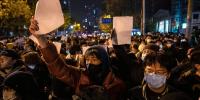
In Shanghai, a vigil grew into a street protest where many held blank sheets of white paper in a symbol of tacit defiance.
In Beijing, students at Tsinghua University raised signs showing a math equation devised by the Russian physicist Alexander Friedmann, whose surname in Chinese is a homonym for “free man.”
On September 27, 2022, a song by Iranian musician Shervin Hajipour ‘broke’ Persian social media. Hajipour posted a video on Instagram of himself singing a song for the mass protests that began in Iran following the death of Jina (Mahsa) Amini. Its lyrics were composed of tweets from members of the Iranian Twittersphere explaining what the protests meant to them, what they were fighting for and what was at stake with the hashtag #برای (for the sake of).
Food transcends language—it brings people together, bridges cultures, and tells stories words cannot. In early March, the Razom Advocacy team, alongside renowned Ukrainian chef Olia Hercules, embarked on a journey through Louisiana—visiting Shreveport and New Orleans—to foster connections, celebrate Ukrainian culture, express gratitude to local first responders, and advocate for Ukraine.
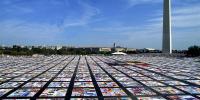
Cleve Jones's powerful vision for memorializing those lost to AIDS was realized in October 1987 in Washington D.C. It showcased the artistic contributions of people who'd lost loved ones to the virus from a number of US metropolitan centers. The quilt has continued to grow for the nearly 40 years since. By 1992, the AIDS Memorial Quilt included panels from every state and 28 countries.
Several nights of Halloween celebration in Shanghai provided a vivid, if indirect, commentary this week on the malaise gripping the world’s second-largest economy.
Since the 1980s, revitalizing the economy has always been the country's development strategy. Although China's economy has grown rapidly in just twenty years, attracting worldwide attention, environmental destruction has also become a problem. For example, the Fu Nan River in Chengdu, like many rivers nationwide, is severely polluted.
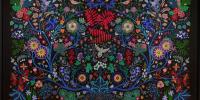
The Wisdom of the Universe was painted in 2014 by Métis artist, author, and activist Christi Belcourt. Based in Northeastern Ontario, Belcourt is best known for her large-scale acrylic paintings — like this one — that use hundreds of thousands of tiny dots to simulate Métis beadwork. At the Art Gallery of Ontario, where The Wisdom of the Universe lives, the painting has become a popular sight.
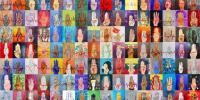
Whether your family’s traditional dress is a Mexican huipil, an Indian saree, or a Scottish kilt, where do you usually wear these clothes?
In Ukraine, the traditional attire is a vyshyvanka. Typically made of cotton or linen, these shirts feature embroidered patterns along the front, collar and sleeves.
The beacon flashed incessantly. On. Off. On again.
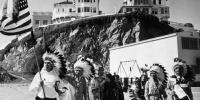
Like some sort of traffic light gone crazy, it pierced the thick nighttime mist hovering over San Francisco Bay. The light sent a message five miles across the dark waters from Ghirardelli Square to Alcatraz Island. There, cheers erupted as the light flashed the words, "Go Indians!"
The resistance to Trump’s ICE militia is strong and is documented in the online art exhibition, “ABOLISH ICE” https://sites.google.com/view/abolish-ice/home The participating artists-activists are from New York, Connecticut, Pennsylvania, New Jersey and California.
When Jonathan D. Chang visits the 626, he often wears a black hoodie emblazoned with a colorful print of Guangong on the back. A military general from the Three Kingdoms era turned Taoist guardian deity, Guangong, or Guan Yu, is known throughout China and parts of Vietnam as a symbol of wealth and protection. Chang’s hoodie features his own design of the deity, which he drew in classic chibi fashion with a big head and smaller limbs.
On the small island of Teshima in Japan’s Seto Inland Sea, Multibasket – No One Wins invites visitors to reconsider competition, collaboration, and the intersection of art and play.
Empathy may be the cornerstone of any Global Justice movement, but how do we cultivate the conditions for empathy to thrive?
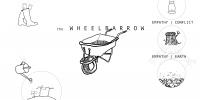
The wheelbarrow symbolises something universally useful, practical and pleasingly straightforward. A space to deliver things in an efficient and direct manner - no packaging and completely people powered.
First cut the banks! In 2012 Bankia declared itself bankrupt and, almost immediately, asked the Government of Spain for €23 billion. The Government accepted, yet that very same week ordered €20,000 million worth of cuts in health and education. It was then that we realized that what they called a crisis was actually a scam. You wouldn’t believe how pissed off we were. So we threw a party, because there is nothing like partying to relieve your anger.
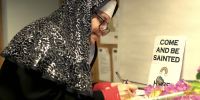
As she puts the finishing touches to her habit, Sister Clarita, a Mexican immigrant living in Los Angeles, tells me that there are more than 3,000 LGBT+ nuns around the world. They’re part of the Sisters of Perpetual Indulgence, an international network of activists who identify as secular nuns.
Myanmar has been engulfed in protest since February 1, when Burmese army general Min Aung Hlaing seized control of the government in a military coup, refusing to accept the landslide election victory of the National League for Democracy and its leader, Aung San Suu Kyi.
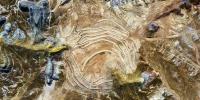
At first, you don’t know what you’re looking at. A gray expanse of uneven geometry surrounded by undulating brown. Shift your perspective a bit and it might be a close-up of a distressed textile, with subtle hues and textures surfacing as your eyes adjust.
And then the horizon comes into focus. Now you know where you are. In the distance are the classic jutting buttes of Monument Valley, familiar to anyone who’s ever seen a John Ford Western.
Singaporean artist Lee Wen’s series Journey of a Yellow Man (1992–2012), one of his most famous and long-standing performances, was not simply a personal affront, it was a political affront. At the intersection of Asian art history, critical race theory, and migration and diasporic studies, one is never far (enough away) from the chromatic framing of race and ethnicity: yellow race, yellow peril, yellow face, the forever foreigner.
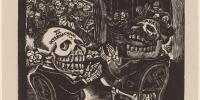
Born on June 30, 1902, in Mexico City, Leopoldo Méndez would become one of Mexico’s most significant and beloved graphic artists of the twentieth century. Méndez was one of eight children in a poor household. At a young age, Méndez used art as a means to bring joy to the Mexican community and attended the Academy of San Carlos located in Mexico City.
On the eve of Wells Fargo’s annual shareholders meeting in San Antonio, TX on Tuesday, home defenders, students, community groups, and activists in ten cities took peaceful action against the bank. Petitions signed by thousands of people were delivered to Wells Fargo branches and offices across the country calling on CEO John Stumpf to change the bank’s predatory practices.