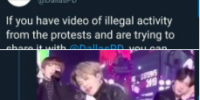
If you’ve spent a decent amount of time on Twitter, you’re probably familiar with the concept of K-pop fancams. The short clips of live performances, primarily by South Korean acts, often dominate replies on the app and are hated by many. This week, however, the social phenomenon has taken over in a different way: to fight for the rights of Black Lives Matter protesters seeking justice after the death of George Floyd.
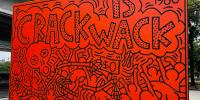
Without having been commissioned—or even given legal permission at all—Haring set out to create Crack Is Wack on the wall of an abandoned handball court in a park at 2nd Avenue and East 128th Street on June 27, 1986. Upon the completion of the mural, Haring was arrested by the New York City Police Department for vandalism of city property and faced potential jail time in addition to heavy fines.
For Women’s History Month 2024, Hysterical Collective presented: Hysterical: Radical Creativity – the third instalment of the annual charity art exhibition and cultural programme taking place in March each year. Co-founded and curated by Eliza Hatch of Cheer Up Luv and Bee Illustrates, Hysterical is a queer and feminist-led exhibition and event showcase; centred around community, collaboration, and activism.
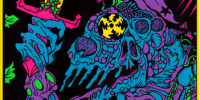
King Gizzard & The Lizard Wizard have released a pair of live albums to benefit relief efforts in response to devastating wildfires in their native Australia.
The play celebrates the life and legacy of the Mexican-American labor activist César Chávez. His early life as well as his partnership with Dolores Huerta, activism with the National Farm Workers Association, the 1968 grape boycott, and his ongoing commitment to nonviolent civil rights work.
Children in marginalized communities often lack access to healthy foods, especially fresh fruits and vegetables. Poor nutrition, in turn, has significant negative impacts on a child’s health and ability to focus in school. Learning and academic achievement often plummet.
During the Black Lives Matter protests in Richmond, VA, the two fourteen-year-olds posed in a powerful photo in front of Confederate General Robert E. Lee’s statue. Ava had originally arranged an appointment with photographer Marcus Ingram, but as she and Kennedy posed in front of the graffiti-covered monument with their fists firmly jutted in the air, several photographers began snapping pictures.
Shackles. Cotton. The Big House.
Americans tend to think of slavery in terms of chattel slavery. Plantation Slavery. Slavery where human beings are bought, sold, and owned. The kind outlawed in the United States by the Emancipation Proclamation in 1863.
Slavery as a relic of the 19th Century.
“Six of us lived, worked, slept in a 10-by-10 (foot) room without a bed, bathroom, or clean water,” Nasreen Sheikh remembers.
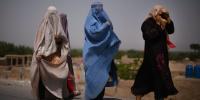
In December – as many around the globe were preparing for the holidays – Sama, a former attorney, remained hunkered down in her house in Kabul, Afghanistan, trying to comprehend how her world had changed.
Destin from the Youtube channel Smarter Every Day has started the "Hunstville Fighting Covid" website in order to mobilize and teach those who have 3D printers how to print Personal Protective Equipment to aid medical professionals fighting the COVID-19 epidemic.
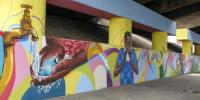
In a bid to fight the spread of COVID-19, the EU Delegation to Ghana on Wednesday 27 May joined the International Organisation for Migration (IOM), the Accra Metropolitan Assembly (AMA) and artists from the Ghana Graffiti Collective, to launch an initiative to use street art and graffiti to create awareness about coronavirus and migration.
The artwork created by the Ghana Graffiti collective speak about hope, tolerance, love and solidarity.
Filmmaker Michael Moore has called for a nationwide boycott of Walgreens after the pharmacy chain announced it would not sell abortion pills in 20 states.
n February, 20 Republican state attorneys general wrote to Walgreens Corp. threatening legal action if Walgreens provides the abortion pill, mifepristone, to consumers in their pharmacies across the U.S.
Environmental activist Ella Daish has created a giant tampon applicator as part of a protest against single-use plastic. The piece is made out of period plastic found polluting beaches, waterways, and local ecosystems in the UK. Daish sourced 1,200 applicators from 15 different locations across the United Kingdom. Of the plastic applicators collected for the project, 87.5 percent came from one brand, Tampax.
Gao Yaojie (Chinese: 高耀潔, Gao Yaojie; 19 December 1927 – 10 December 2023) was a Chinese gynecologist, academic, and AIDS activist based in Zhengzhou, Henan, China. Gao was honoured for her work by the United Nations and Western organizations whilst spending time under house arrest.
This is the sixth piece of the series Tatlin’s Whisper which examines the relationship between apathy and anaesthetization of the images in the mass media. This series intends to activate images, well-known because of having been repeatedly seen in the press, but are here decontextualized from the original event that gave way to the news and staged as realistically as possible in an art institution.
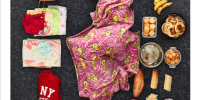
In response to an earlier project called "Daily Bread, Gregg Segal collaborated with the United Nations Refugee Agency to bring awareness to the crisis of refugees fleeing Venezuela through his project "Un-Daily Bread."
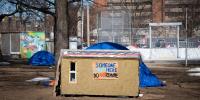
On his way to work on a construction site, Khaleel Seivwright surveyed the growing number of tents lining an intercity highway and in parks with increasing discomfort. How would these people survive Toronto’s damp, frigid winters, let alone the coronavirus, which had pushed so many out of overcrowded shelters?
He remembered the little shanty he had once built out of scrap wood while living on a commune in British Columbia.
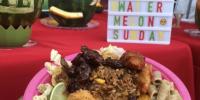
Starting in 2019 out of the East Harlem neighborhood in New York, Watermelon has served as recurring series of cookout-themed events that are 100% vegan, while also centering BIPOC businesses. People from all over the city come to the reoccurring events to enjoy different vegan recipes and learn about different aspects of the vegan lifestyle and activism. Brands and organizations are welcome to participate upon coordination with the organizers.
“What Is Missing?” is a multi-sited memorial created by Maya Lin to raise awareness through science-based artworks about the present sixth mass extinction of species, connect this loss of species to habitat degradation and loss, and emphasize that by protecting and restoring habitat, we can both reduce carbon emissions and protect species.
In 2023, it is impossible to be an apolitical artist in Eastern Europe. As war rages on in Ukraine, art serves as a powerful and necessary tool, according the members of the Sunflower Solidary Community Center in Warsaw: Maria Beburia, Sebastian Cichocki, Kuba Depczyński, Taras Gembik, Yulia Krivich, Kaja Kusztra, Natalia Sielewicz, and Bogna Stefańska.
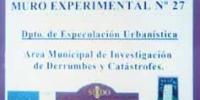
This action was suggested in the workshop assembly by a neighbor of Arrayán street itself. At the end of this street giving the market there was a wall in a state of collapse that
concerned the neighborhood. On several occasions, either neighbors or from the same Peña Bética in front of them, they had
given by the City Council, but without results. And every day having to go all the way through that gorge with two
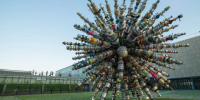
For one artist, the ugly and the beautiful are equivalent concepts. In 2018, designer and artist Choi Jeong Hwa featured an exhibition titled 'Alchemy' at The Artling where he uses recycled and non-biodegradable materials in his work that he has been collecting for 30 years, such as household trash, glass, and steel. 'Dandelion' is one of his masterpieces installed in the outdoors in Seoul, South Korea.
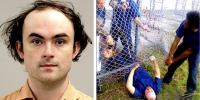
William Banks is a comedian and artist who, prior to his viral prison saga in 2025, was best known for a community that he led called Call World, which he describes on the website as “a planet in an alternate universe ruled by human-headed Worms sexually obsessed with William Banks.” The story goes that Banks was first visited by a worm from Car World after getting stuck in an industrial freezer and coming to terms with his death before eventually being